Apple’s Hidden Siri AI Limit: What Really Happens When You Run Out?
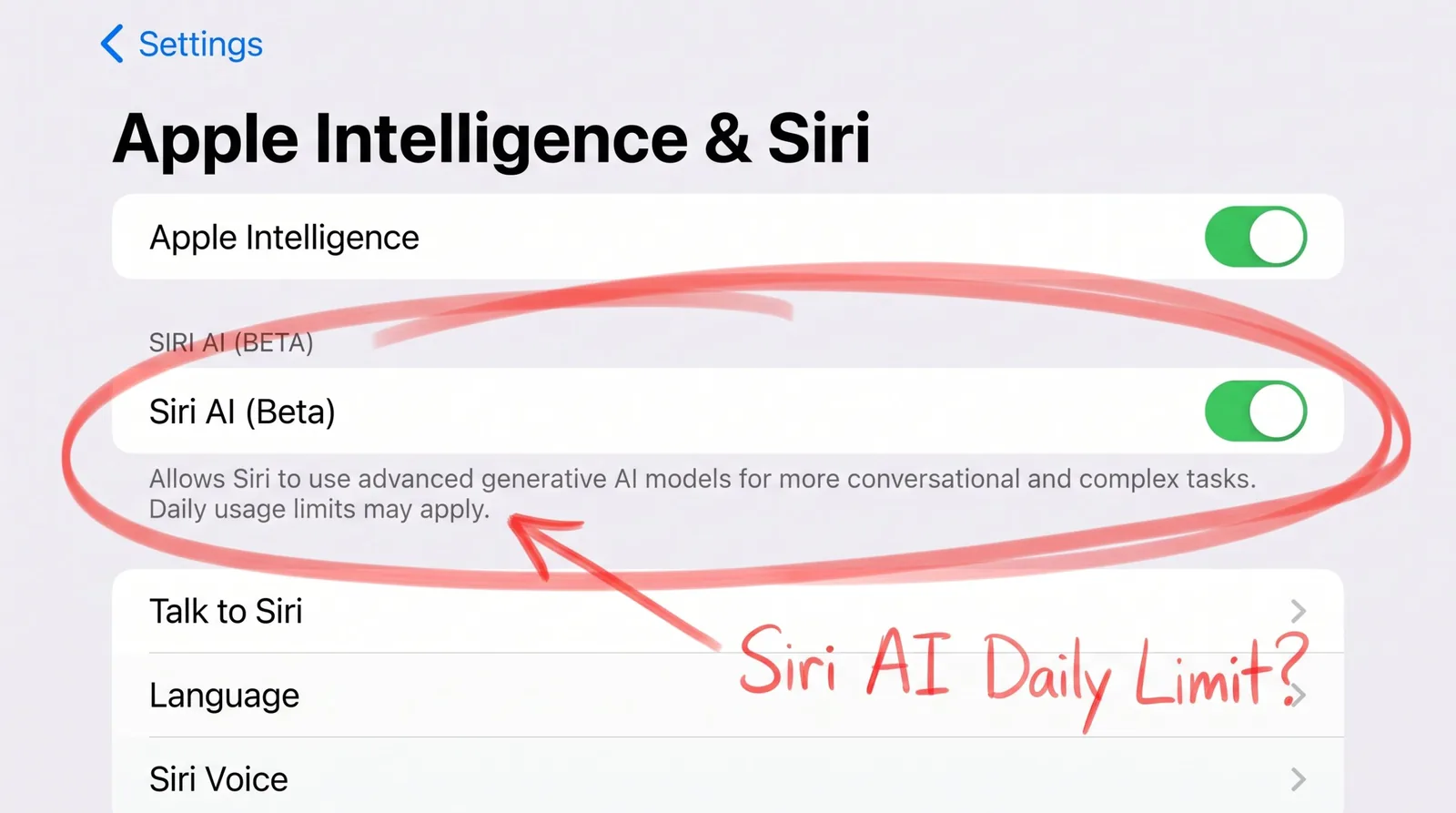
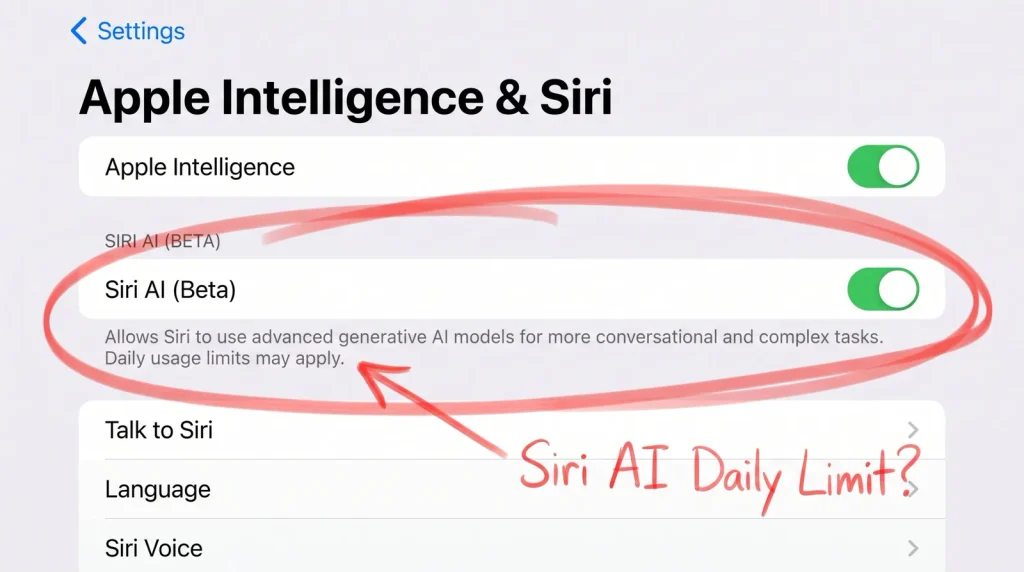
Siri AI Daily Limit: What Actually Happens When You Hit It

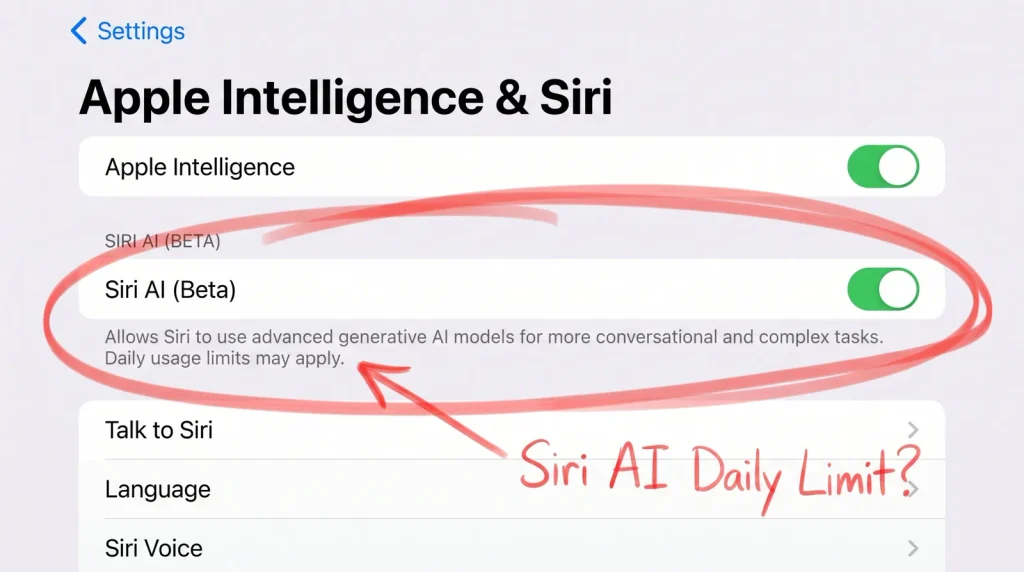
Siri AI has a daily usage limit on iPhone, but Apple won't say the number, the timeout length, or when enforcement starts. Two Apple support pages even disagree on tense — one says limits are coming "in the future," the other says they already "may" apply. Here's what Apple has confirmed, and what to do if a request stops working.

Key takeaways

- Apple confirms Siri AI, Image Playground, Intelligent Photo Editing tools, and AFM 3 Cloud models in Shortcuts are all subject to usage limits — but discloses no specific daily number for any of them.
- When you hit a limit, Apple says the feature "will become available again after a time out period" — it does not state how long that period is, and it can vary by feature and system demand.
- Apple's usage-limits support page describes a fee-based "enhanced access" tier arriving with 2027 software releases — not something you can buy today.
- A separate Apple legal document, the Apple Intelligence Usage Terms, describes limits as already in force ("current and future… may be subject to usage limits"), which is not what the usage-limits page implies.
- Apple already runs a tiered-access model elsewhere in Apple Intelligence — Home app video summaries are capped at 1, 2, or 5 cameras depending on your iCloud+ plan — which is the closest real precedent for how a Siri AI paid tier could eventually work.

What Apple has actually said about the Siri AI daily limit

Apple's support document on the subject, "Learn about Apple Intelligence usage limits," names the specific features this applies to: Siri AI, the Intelligent Photo Editing tools (Clean Up, Extend, and Spatial Reframing), Image Playground, the AFM 3 Cloud and AFM 3 Cloud Pro models available to Shortcuts, and developer apps that call Apple Foundation Models through Private Cloud Compute. Apple groups these together because each one depends on server-side processing rather than running entirely on your iPhone, which is also why they're the features capped — server capacity, not your device, is the constraint.

The document's own explanation is short: "Limits may vary by feature, request complexity, system demand, system policies, and other factors." That single sentence is doing a lot of work. Two people could ask Siri AI the same question, on the same day, on identical iPhone models, and hit the limit at different points. Apple has deliberately left itself room to throttle based on how busy its servers are at that moment, not a fixed quota per account.

Apple has not published a number anywhere — not in this support document, not in the Apple Intelligence Usage Terms, not in the Siri AI Newsroom announcement. Every outlet that has reported "Apple confirms daily limits" is citing the same document you can read yourself; none has an actual figure, because Apple hasn't released one.

Is the limit already active, or does it start in 2027?
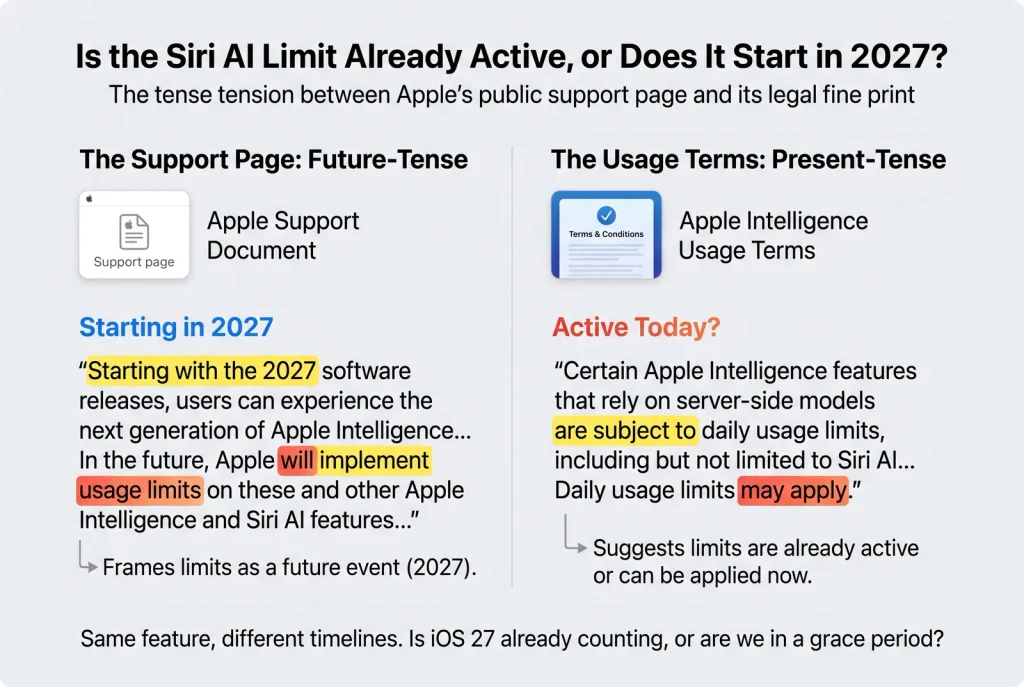
his is the part Apple’s own materials don’t agree on, and it’s the genuine unanswered question behind every “Siri AI has usage limits” headline.
The usage-limits support page frames the whole thing as forward-looking: “Starting with the 2027 software releases, users can experience the next generation of Apple Intelligence, with enhanced access to features that rely on server-side models… In the future, Apple will implement usage limits on these and other Apple Intelligence and Siri AI features.” Read on its own, that sentence points to 2027. The limits, and the paid tier that lifts them, sound like a next-year change — not something switched on with iOS 27 today.
But the Apple Intelligence Usage Terms, the legal document every Apple Intelligence feature is governed by, is written in the present tense: “Current and future Apple Intelligence Features may be subject to usage limits. Limits may vary by feature. Apple reserves the right to modify which Apple Intelligence Features are subject to limits and the applicable usage limits at any time.” Nothing here says the limits wait for next year’s software. It reads as already in effect, with Apple free to adjust them at will.
Neither page contradicts the other outright. “May be subject to” is vague enough to cover a limit that isn’t actively enforced yet. But a reader can’t tell from either document alone whether asking Siri AI a question today carries any real risk of hitting a wall. The practical answer, until Apple clarifies further: treat the limit as live now. The Usage Terms are the document that actually governs your account, and it doesn’t promise you a free pass until 2027.
What happens when you actually hit the limit
Apple describes the mechanism in one sentence: “If you reach a limit in a particular feature, that feature will become available again after a time out period.” A few things follow directly from that wording:
The restriction is per feature, not account-wide. Hitting a cap on Siri AI requests doesn’t appear to disable Image Playground or the Shortcuts AI models — each is named separately as its own limited feature.
There’s no stated countdown. Apple gives you no on-screen timer or estimate for how long the “time out period” lasts. Combined with the “may vary by… system demand” language, the honest expectation is that it’s inconsistent — possibly minutes at low-traffic times, longer during a peak like a keynote or a major iOS release.
It resolves on its own. There’s no indication you need to restart your iPhone, sign out of Siri AI, or change a setting — Apple’s description is that the feature becomes available again by itself once the timeout passes.
The separate “unreasonable use” clause in the Usage Terms is worth knowing about too: automated, scripted, or bulk-style use of Apple Intelligence can be “restricted, throttled, suspended, or subject to additional limits” independent of the ordinary server-capacity limit. A single unusually long Siri AI conversation is very unlikely to trip this; it’s aimed at abuse, not normal use. Still, it means two different kinds of limit exist in Apple’s language, and only one of them is the everyday capacity cap this article is about.
The iCloud precedent: how Apple already tiers AI features by plan
Apple hasn’t said what “increased access” to Siri AI will look like once it’s for sale, but it has already shipped a tiered-access model elsewhere in the same support document — and it’s the clearest hint available.
Apple’s own note under this table in its support document — “supported camera counts and other iCloud+ plan features may change over time” — is a hedge worth reading literally: whatever Siri AI’s paid tier looks like when it ships, this pattern implies it will most likely raise your ceiling rather than remove one, and it may well be tied to iCloud+ tiers you already pay for rather than a new standalone Siri AI subscription.
Will you actually have to pay for “expanded access”?
Not yet, and not for the base experience. Read literally, Apple’s language ties the fee to the next generation of Apple Intelligence arriving with 2027 software, not to iOS 27’s Siri AI as it exists on your iPhone right now. The exact line: “Increased access to such features will be available for a fee.” That’s future tense, tied explicitly to next year’s release, and Apple gives no price, no plan name, and no sign-up path today.
What this means in practice: if you hit a Siri AI timeout in iOS 27, there is currently no purchase you can make to remove it. Anyone online claiming to know the price of “Siri AI Plus” or similar before Apple names one is speculating — Apple’s Fine Print, as one outlet accurately labeled this document, discloses the existence of a future paid tier and nothing about its shape.
What to do right now if you hit a Siri AI limit
A few concrete options, based only on what Apple has confirmed:
- Wait. Apple states the feature returns on its own after a time-out period — there’s no fix beyond letting it pass.
- Fall back to on-device Siri for simple requests. Timers, alarms, calls, texts, and basic device commands don’t require the server-side Siri AI model, so they aren’t part of this limit.
- Don’t expect the limit to correlate with your iCloud+ plan yet. Unlike the Home app camera example, Apple has not said Siri AI’s current limit varies by iCloud+ tier — the tiering example above is a precedent, not a confirmed rule for Siri AI today.
- Check whether it’s Siri AI specifically. If Image Playground or a Shortcuts action using the AFM 3 Cloud model also stalls at the same time, you’re likely seeing a broader server-demand period rather than something specific to your account.
- Recheck later rather than assume today’s silence is permanent. Apple has not committed to a timeline for disclosing a number, but this is the one support document that would carry it if and when it appears — CupertinoOS will update this piece if Apple discloses one.
Frequently asked questions
- Is there an exact number of Siri AI requests I get per day?
Apple has not published one. Its usage-limits support document states limits vary “by feature, request complexity, system demand, system policies, and other factors” rather than giving a fixed count. - How long does the Siri AI timeout last?**
Apple doesn’t say. It describes only that the feature “will become available again after a time out period,” with no stated minimum or maximum duration. - Can I pay to remove the Siri AI limit right now?**
No. Apple ties the fee-based “increased access” to Apple Intelligence’s next generation, arriving with 2027 software releases, and has not opened sign-ups or announced pricing for iOS 27. - Does the Siri AI limit apply the same way to every iPhone?**
Apple doesn’t say the limit differs by iPhone model. It’s described as a server-side capacity limit tied to the feature itself, not a per-device allowance — though only Apple Intelligence-capable iPhones can use Siri AI at all. - Will using Shortcuts’ AI features count against my Siri AI limit?**
Apple lists them as separate line items — Siri AI and “AFM 3 Cloud and AFM 3 Cloud Pro Models in Shortcuts” appear individually in its features list, suggesting they’re tracked and limited independently rather than sharing one pool.
Bottom line
Apple confirmed a real limit exists and then declined to say almost anything useful about it: no number, no duration, and two of its own documents that don’t quite agree on whether it’s active today or arriving with next year’s software. The legally binding Usage Terms describe limits as already possible and adjustable “at any time.” That makes the safer assumption, for any iPhone owner, that the cap can apply now rather than in some future release — and that no amount of money fixes it until Apple actually opens a paid tier. Until Apple publishes a real number, the iCloud+ camera-tiering precedent is the best clue available for what “expanded access” will eventually look like.
Sources